-
This very morning, I caught myself again—scrolling past a headline that should have stopped me cold. Another raid. Another detention center built to house immigrants. Another politician peddling cruelty as “common sense.” Perhaps because it feels too painful to absorb. Or too distant to change. Or maybe—if I’m honest—because I’m growing indifferent.
That’s what this reflection is about: the creeping indifference that is at work in so many of us. I can feel it in me. And I will not allow it to become my state.
There’s no doubt—we’re all being conditioned, slowly and methodically, to not flinch at the suffering of others. We are numbed by algorithmic news and trained by the headlines to skim past pain as if it were mere spectacle. We begin to confuse emotional detachment with maturity. We shrug and say, “What can we really do?”—as if apathy were a virtue. And over time, the call to neighborly compassion is replaced by muted moral distance. Indifference: the opposite of love.
But this numbing carries a cost. It requires us to surrender the basic human instinct to respond to pain. And for those within the Christian tradition, it demands that we surrender the gospel itself—for something smaller, weaker, and ultimately abusive and false.
Let me be clear: this is a pastoral lament. Yet I know there are some who can only hear these words through a partisan filter—because political identity has become the only lens they’ve been trained to use. But for those with spiritual ears to hear, this is about what happens to our humanity—and to the witness of the Church—when we stop being disturbed by injustice, suffering, and cruelty.
In Luke’s Gospel, Jesus tells the story of a wounded man left on the side of the road. The ones who strolled passed him by were the religious leaders. The moral citizens. People with credentials and civic pride. But they walked past suffering because it didn’t fit their agenda. Because it was inconvenient. And, frankly, because of their disgust for the one suffering. It was the good Samaritan—racially, religiously, and politically other—who stopped, who saw, who was moved to act.
That story is not ancient history. It’s a mirror.
So hear me—especially my white, affluent, church-associating peers:
Your bumper-sticker patriotism is salt in the wound of those suffering under the guise of “making America great again.” Your casual “I’ll pray for the president” is a punch in the face of the immigrants stripped of their humanity and locked in for-profit detention centers. Your silent nods toward cruelty-as-policy are not political neutrality—they are a grief to the God of justice and a desecration of the image of God in those being targeted.Still, even as I lament what’s happening “out there,” I am pastorally concerned about what’s eroding “in here”—in me, in my family, in the insulated, predominantly white spaces I move through. The creeping indifference that masquerades as social balance. A spiritual detachment that can sing worship songs but cannot wail for the suffering.
I’ve heard Christians say, “But they broke the law…” as if that justifies literal cages for men, women, and children whose only crime is the color of their skin and immigration from their country of origin. (Most reports estimate that over 70% of those arrested by ICE have no criminal record other than their immigration status.) To which I ask: What law are you most loyal to? Because it’s clearly not the law of God. Scripture is explicit: Welcome the stranger. Care for the foreigner. Love your neighbor.
Let me say it plainly: if your theology makes peace with imprisoning people for the “crime” of being an immigrant, then it is not the gospel you are following.
When images of separated and detained children no longer stir us to action…
When we hear of detention camps and commodified cruelty and feel nothing…
That is not moral clarity. That is moral decay.And yet somehow, many of us—especially in white Western Christianity—have confused faithfulness with emotional numbness and walking past the issues of our day. As if God’s peace requires detachment. As if faithfulness means not getting dirty. Indifference is not a fruit of the Spirit.
So what do we do?
I don’t yet know the final required actions. But, we must start by telling the truth. We name the indifference—in ourselves, in our churches, in our circles of influence. We confess the ways we’ve made peace with cruelty and violence because it helps us stay comfortable. Then we look even deeper.When the headline scrolls past—pause. Let it hurt.
When someone reduces a life to a label—resist. Ask for their story and listen.
And remember, silence is rarely neutral. Loving action will be required.We were never called to stroll past suffering. We are called to see, to stop, and to love. Because numbness is not peace. Emotional distance is not maturity. And indifference is not Christlike.
-

I’ve been thinking a lot about Jeremiah. The prophet, yes. But also my friend.
My friend Jeremiah has been on a spiritual journey these past couple of years. I’ve had the joy of walking alongside him as he explores the Christian faith with fresh eyes. Recently, he expressed interest in joining a local faith community. So we’ve been visiting churches together—across traditions, aesthetics, and theological expressions. After each visit, he turns to me and asks, “What do they believe here?”
He’s not asking for a doctrinal statement. What he means is: What’s underneath all this? What’s the animating story behind this form of performance? What kind of God is being imagined and celebrated here? And, is this really all that church is?
Behind his question, I hear something deeper—a quiet ache. A lament-laced longing for something more than spiritual entertainment or ritual maintenance. A longing for something real. Something active in the neighborhood. Something that clearly communicates good news and acts of relief for the suffering.
My recent post, Yes, I Am Sad, seemed to strike a chord with some—and it’s true. I am sad. I’m heartbroken over how fragmented, distracted, and disoriented the church has become. We’ve traded a liberating invitation for afterlife coping mechanisms and culture-war theatrics. We’ve become preoccupied with securing power instead of self-emptying love. In the process, we’ve neglected the very things Jesus said matter most: the blind see, the lame walk, the hungry are fed, the naked are clothed, the imprisoned are set free, the widows are defended, and the immigrants are welcomed.
And here’s the thing: the prophet Jeremiah was sad too. He is often called the weeping prophet.
“Oh, that my head were a spring of water and my eyes a fountain of tears,
so that I might weep day and night for the slain of my people.” (Jeremiah 9:1)Jeremiah’s tears weren’t a sign of fragility. They were a form of resistance. A refusal to normalize empty religious routines. A refusal to imagine God in the image of power over others. A deep, embodied protest against numbness and indifference to the neighbor.
Jeremiah lived through the unraveling of his nation’s religious and political identity. He saw the temple corrupted, the marginalized crushed, the leaders indifferent. And still, he kept showing up—with lament, with courage, and with a heart torn open by grief.
I believe we’re living through a similar unraveling. And I believe we need a similar kind of courage—not a desperate attempt to rebuild what was, but a prophetic imagination to dream what could yet be… and the patient faith to live into it.
So, my friend Jeremiah—since you asked—I will imagine here with you for a while. There is no five-step plan. That’s part of the point. But I do see signposts of hope, hints of a different kind of faithfulness. And so, alongside my friend—and the ancient prophet too—I will practice holding sorrow and imagination at the same time. Maybe that’s how hope works.
I’m Imagining a Church That…
Feels Less Like a Performance and More Like a Shared Practice
Less about showing up on Sunday, and more about showing up for each other every day. Less like a stage, more like a shared table—or a community restoration project. Less like a talent show, more like a circle of honest friends. Something like AA.These are communities of common practice where vulnerability isn’t just allowed—it’s expected. They’re not built around programs but participation. Not hype, but help. Not crowds, but connection.
Because when I look at what is, I’m reminded of Jeremiah’s warning: “Do not trust in these deceptive words, ‘This is the temple of the Lord, the temple of the Lord, the temple of the Lord!’” (Jeremiah 7:4)
Jeremiah called out a system that had turned sacred space into performance theater. A religion that had traded relationship for ritual. Presence for presentation. And we need that same level of lament now. We need less emphasis on spiritual experiences or encounters and more encouragement to live our lives truthfully and attentively—together.
Makes Space for Mystery
Certainty has become a drug the church can’t quit. We treat inerrancy like oxygen—as if truth will suffocate without our explanations. But mystery isn’t the enemy of faith. It’s its habitat.The truth is…inerrancy, more often than not, becomes a scapegoat for abuse—a way to silence, control, and dominate. We need to let Scripture become a doorway for meditation, not a hammer for manipulation. A place to wrestle, to wonder, to sit in silence, to seek, to suffer, and to discern new things…
We need a story of God that doesn’t pretend to explain everything, but dares us to trust—even in the dark, even in the silence.
Trusts in Slow, Non-Anxious Leadership
Pastors don’t need to be impressive. They need to be present. We don’t need charisma. We need grief-holders. We don’t need bigger platforms. We need small space-makers. We don’t need better branding. We need someone who will sit on the ash heap when nothing makes sense.This is the kind of leadership Jeremiah embodied. He was ridiculed, ignored, dismissed—and still he stayed. Still he spoke. Still he wept. And he also raged against religion that avoided the real wounds and pain of the people:
“They dress the wound of my people as though it were not serious.
‘Peace, peace,’ they say, when there is no peace.” (Jeremiah 6:14; 8:11)It was a protest against shallow comfort, cheap grace, and careless hope. A protest on behalf of the wounded and the overlooked. Yes, we need pastors who will sit on the ash heap more than they stand on a stage. Pastors who will march in the streets more than they pace behind the pulpit. Pastors who feed the poor more than they administer the sacrament.
Plants Gardens in Exile
We are not in Jerusalem. We are not in Christendom. And that’s okay. The prophet’s words to the exiles still speak:“Build houses and live in them; plant gardens and eat what they produce…
seek the peace of the city where I have sent you.” (Jeremiah 29:5–7)This is the slow, faithful work of transformation. Not spectacle. Not dominance. Just yeast, seeds, tears, and love. The Church that’s coming won’t be the one that “takes back the culture.” It will be the one that dares to live with it, serve in it, and love it—quietly, fruitfully, faithfully.
Lets Go of Empire Logic and Strategies
Jeremiah didn’t offer a strategy for success. He offered an invitation to surrender. The Church of the future won’t be measured by attendance, followers, or members. It will be measured in mercy.“I will give them a heart to know me,” says the Lord, “that I am the Lord. They will be my people, and I will be their God.” (Jeremiah 24:7)
That kind of knowing doesn’t come through noise or being the center of attention. It comes through giving attention—especially to those on the margins, the overlooked, the voices we seek to silence.
So yes, Jeremiah—the prophet Jeremiah was sad too. And maybe that’s not a problem to fix. Perhaps it’s the path to follow.
A sadness that refuses to look away. A sadness that breaks open into truth. A sadness that plants gardens in the rubble and care-takes the soil beneath its own feet. A sadness that imagines—and actively embodies—a different kind of faithfulness and community.
-
Walter Brueggemann, who died this past week at the age of 92, was among the most influential biblical scholars of our time — and one of its most courageous Christian voices.
Through more than 120 books and a lifetime of teaching and preaching, he invited us to hear the ancient texts not as relics, but as ever-enlivened speech: disruptive, hopeful, unsettling, and fiercely relevant. His writings on the prophets, the psalms, the land, and the imagination have shaped how pastors preach, how communities practice, and how we understand the relentless contest between empire and the kingdom — both in us and around us.
But Walter was not simply a scholar; he was a prophetic presence. His voice carried the cadence of the prophets he loved — daring, poetic, insistent, and full of faith. He read both scripture and the world with eyes wide open, refusing the comforts of denial or despair. And even outside the pulpit or the page — in the most ordinary of everyday conversations — he carried that same prophetic attentiveness.
It was following one such conversation — as we sat reading together at his kitchen table, reflecting on the ancient idea of the either/or choice — that Walter once wrote of our friendship.
In his essay Two Farmers, Two Ways, he reflected on our conversation about the either/or choice that is ever before us: whether to live by anxious control or in generative trust. Whether to serve the commoditizing powers or to be responsively led by good news possibility.
Walter never pretended these either/or choices were easy — nor did he allow them to fade into abstraction:
“The reason that this declaration is so urgent is that the ‘Canaanite’ alternative appears to offer a life of ease, comfort, and security, when in fact it is a way of the destruction of self, neighbor, community, and eventually of creation.”
Nor did he let us forget its modern, public consequence:
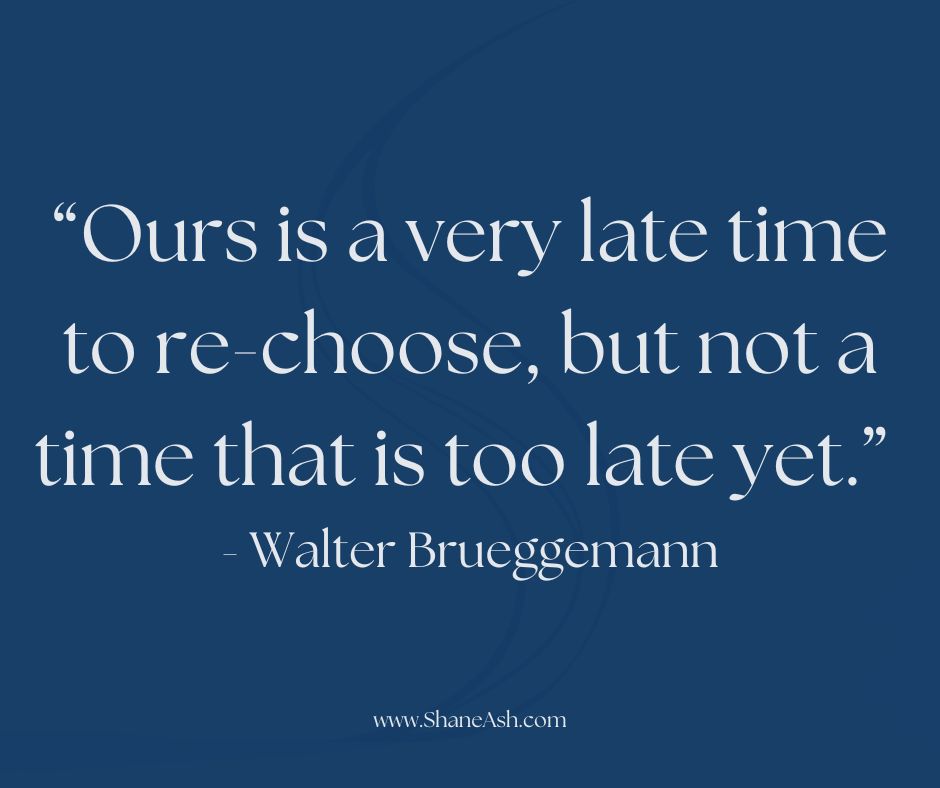
“A socio-economy that gives tax preference to the wealthy… that is grudging in its support of the needy… that programmatically destroys its own environment is a society that has chosen death and is engaged in relentless self-destruction. The utterance of the either/or suggests that ours is a very late time to re-choose, but not a time that is too late yet.”
Walter taught me — and so many of us — that the choice between anxiousness and generative grace is not one we make just once. It is a choice set before us again and again: in boardrooms and in pulpits, in voting booths and social media posts, at the kitchen table, and yes, even in farmyards and backyards.
As I remember it, when Walter and I sat reading together at his kitchen table, it was no academic exercise. It was a personal reckoning. Walter was carefully leading me toward the recognition that decisions between the “two ways” are not simply operative socially, but within each of us — the battle between anxiousness and generous trust waged daily in our own hearts. In our relationships, our parenting, our vocations, and our life decisions. As he wrote: “Our better angels root for us, but in the end we must choose our better selves, on offer as a gift from the goodness of God.”
What that essay does not reveal — but I hear in every line — was the context of my visit to his home and this conversation. I was in the midst of a choosing moment myself… a life decision that stood plainly between anxious striving and generative grace. In both that conversation and the essay Walter sent me afterward, I knew I was being invited — not pushed — toward making a defining choice.
And that was not the first time. Over the past ten years, Walter’s voice has been a consistent guiding presence in our family life — shaping our conversations, decisions, and ways of seeing and being in the world.
On one lighter decision occasion, when our family was debating if we should start a small flock of sheep and/or goats, Walter sent a check with a note… “for the sheep.” It was a simple act that affirmed, embodied, and gently prodded us toward the trust, stewardship of the land, and neighborliness he so often called us to.
Today, as I grieve the loss of Walter’s voice and presence, I returned to his essay. And I hear fresh again the urgency he placed before me — and I feel again the weight of choice.
Walter’s listening and response never led toward ease or mere accommodation. It was about listening for the direction of fidelity, heeding the way that honors neighbor, creation, and human agency — all while daring to say so when public policies, cultural habits, or personal decisions betray those very values.
Now it is up to each of us to keep reading, conversing — and to keep choosing. For certainly, there are choices before us today that are starkly either/or:
- Will we choose fidelity to neighbor, land, and covenant — or surrender to the false gods of profit, power, fear, and want?
- Will we trade neighborly care for authoritarian rule and nationalist myth?
- Will we treat immigrants and refugees with hospitality, or with suspicion and cruelty, stoked by fear-driven politics?
- Will we steward the land and waters entrusted to us, or sacrifice them on the altar of extraction and corporate profit?
- Will we embrace the hard work of socioeconomic justice, or cling to the false security of widening wealth gaps and “trickle down” fictions?
- Will we choose trust and generosity, or anxious control dressed up as “freedom” while the vulnerable pay the price?
As Walter wrote: “…ours is a very late time to re-choose, but not a time that is too late yet.”
Thank you, Walter — for sitting and reading with me in the text of life, for helping me see the stakes, and for reminding us all: The text still speaks. The choice is ours to make. And the Spirit is calling us toward life.
-

A couple of weeks ago, I was sitting across from a pastor I had only briefly met before. We were sharing our stories, slowly revealing more as we recognized the similarity of our paths. Mid-sentence, he looked at me and abruptly asked, “You seem sad. Are you sad?”
The question caught me off guard. It wasn’t one I was prepared to answer in the moment. It wasn’t even a reality I had consciously considered. But it landed with striking clarity…like a key turning a lock I didn’t know existed.
Since then, I’ve been sitting with it. Examining it. Letting it speak.
And yes, I am sad.
There is a deep sadness that resides just beneath the surface of my life. It’s not circumstantial. Not a passing disappointment. It’s broader and deeper…a sadness of the soul. I recognize now that it’s actually been with me for a long time, patiently waiting to be named.
And in reflection, I’ve come to believe this sadness is not something to fix or rush through. It’s something to listen to, to follow, and to let guide.
This kind of sadness is not a sign of despair. It’s a sign of awareness…an awakening to the pain in the air around me. A waking up to the violence embedded in our everyday systems. Waking up to the blasphemy of the Church through its all-too-common disgust of the other and worship of power. Waking up to my own sense of dislocation—from community, belonging, family, and perhaps from calling.
Walter Brueggemann calls this awakening part of the work of prophetic imagination—the work of perceiving and nurturing an alternative consciousness in contrast to the royal consciousness of dominant culture. The starting point of that alternative consciousness, he writes, is lament. And lament can show up in many forms…anger can be a holy and fitting part of lament…and so is sadness.
I am not talking about a private sadness. It is not mere emotional reaction. It is the outcome of increasing awareness and insight…eyes that can no longer just look away from a world that incentivizes non-empathy…where economic engines depend on our distraction, detachment, and denial…where we are numb to the suffering of the poor, actively denying the degradation of the planet and quality of life, medicated by our constant consumption, and desensitized to our racism and supremacy cloaked in religious language.
Everything around us is connected. And everything, it seems, is in pain.
Those who position themselves on the Right are often driven by grievance and anger. The Left by superiority and cynicism. Both are led by fear and addicted to power. Religious conservatives frame themselves as persecuted victims. Religious liberals flinch at personal conviction.
Edit Note: For sure these are broad characterizations that don’t capture the full depth or diversity within either tradition. The real grief here is not about “liberal” or “conservative” Christianity per se, but how both ends—when shaped more by fear and power than love—become reactive opposites within the same broken system. The pain is amplified when these extremes mirror one another, each claiming moral or interpretive high ground all while sustaining the royal consciousness machinery that harms us all.
All of us are, in one way or another, caught in the machinery of a failed system.
Yes, I am sad that conservative Christians are so terrified of a radically hospitable God—one who welcomes the outcast, the queer, the migrant, the heretic—while being comforted by authoritarian political power and a god fashioned in their own image. The fear of losing control, of ceding certainty and superiority, has driven them into the arms of strongmen and systems that promise safety at the cost of compassion and grace.
And I am sad that liberal Christians are so afraid of a radically free God—one who refuses to be domesticated by ideology or reduced to social performance—while being comforted by a law-based moralism often disguised as justice. A justice that often resembles judgment of judgment…a righteousness that trades one purity code for another.
There is a strange cultural clinging to the comfort of causes without examining the community outcomes, the security of being on the “right side,” while fearing the wildness of grace…and the Spirit who blows where She will. It is still control and power—just dressed in different robes.
Yes, I am sad that the language of faith—of resurrection, healing, liberation, and beloved community—has been co-opted by nationalism on the Right, and by a sanitized vocal activism on the Left. We speak of gospel healing, but we have privatized it. We reduced it to a personal prayer project, a self-care plan, or an inner-peace process, rather than courageous, communal, kingdom work.
Of course, gospel healing requires not just inner experience, but social imagination. Not just personal peace, but public reckoning. It requires truth-telling. And therefore, lament in its many forms. And the uncomfortable work of letting go of the gods we’ve made in our own image—whether dressed in patriotism or progressivism—and returning to the wild, untamable, boundary-breaking God who is compassionate Host, great Liberator, and wooing Guide.
Just days ago, in a strangely fitting metaphor, a massive container ship lost control and ran aground—astonishingly close to a seaside home in Norway. The images are surreal: the global machinery of consumption, immobilized in shallow water, absurdly close to destroying a peaceful home. And the homeowner? According to the story…was asleep through it all, completely unaware.
It’s a telling image. What if the pain of the planet, the suffering of the marginalized, and the fracturing of the Church have already run aground—and we are still sleeping? Numb participants. Merely curious bystanders.
In this light, sadness is not weakness, a burden, or something to get over. It is the beginning of resistance. It is the refusal to stay asleep, or at least, it’s enough of a disturbance to wake us up.
Brueggemann reminds us that lament is always the first act of resistance and renewal. And sadness, then, need not be dismissed. It is an active invitation. It is the inner honesty of lament. To be attuned to the groaning of nature and the pain of our neighbor is to share in the grieving heart of God. To be sad is to pray—not with tidy words, but with tears, with silence, with shared suffering.
My faith tells me that sadness is not the end. It is a required threshold. A liminal space. The breaking open of something new. Sadness prepares the ground for hope…not the shallow waters of sentimental faith, but a motivating-hope born amid felt pain, soaked in love, and moved by the Spirit.
So yes, I am sad. And my sadness is my prayer.
-
Over the past two years, I estimate I’ve sat in Spiritual Direction with around 200 different people—different backgrounds, cultures, faiths, and stories. Each person uniquely themselves, yet something strikingly similar keeps showing up… a shared ache. A longing beneath the surface. A quiet yearning to stop performing and simply be real.
For those unfamiliar, Spiritual Direction is an intentionally vulnerable space of spiritual formation—an interpersonal experience of being seen and heard in the presence of another. These conversations are often quiet, slow, and tender—but they are anything but superficial. I’ve come to think of spiritual direction as a thin space for the soul.
What is a thin space? Theologians and mystics have used that phrase to describe moments when the veil between the ordinary and the holy feels unusually sheer—when we become suddenly aware of the sacred that’s been there all along. It’s when our senses awaken, and our consciousness tunes to a deeper presence—some would call it God’s presence. I find it helpful to call it Love.
Some find thin spaces in cathedrals, prayer, meditation, worship, or mountaintop views. I find them most often in shared silence, in a deeply felt story spoken aloud, in the long pause between choosing courage and confession. Yes, I encounter Love most often in the presence and truth-telling of another.
So, thin spaces aren’t just mystical mountaintop experiences—they’re also born in the sacred reality of relational presence. And that kind of deep presence often gets blocked—not by malice or intention—but by our tendency to engage relationships through performance rather than presence.
There have been times I’ve caught myself mid-conversation—whether with a friend or a directee—and realized the real me wasn’t actually there. I was pretending. Offering a curated version of myself: a safer, more certain, more acceptable version.
Performing, simply put, is the act of managing how we’re perceived. We shape our tone, posture, and stories to fit what we think someone else wants or needs. I suppose sometimes that’s necessary in life. But often, it’s just hiding. And when we do it habitually, it steals the possibility of thin space. And there’s no room for sacred presence when we’re busy trying to be impressive or invulnerable.
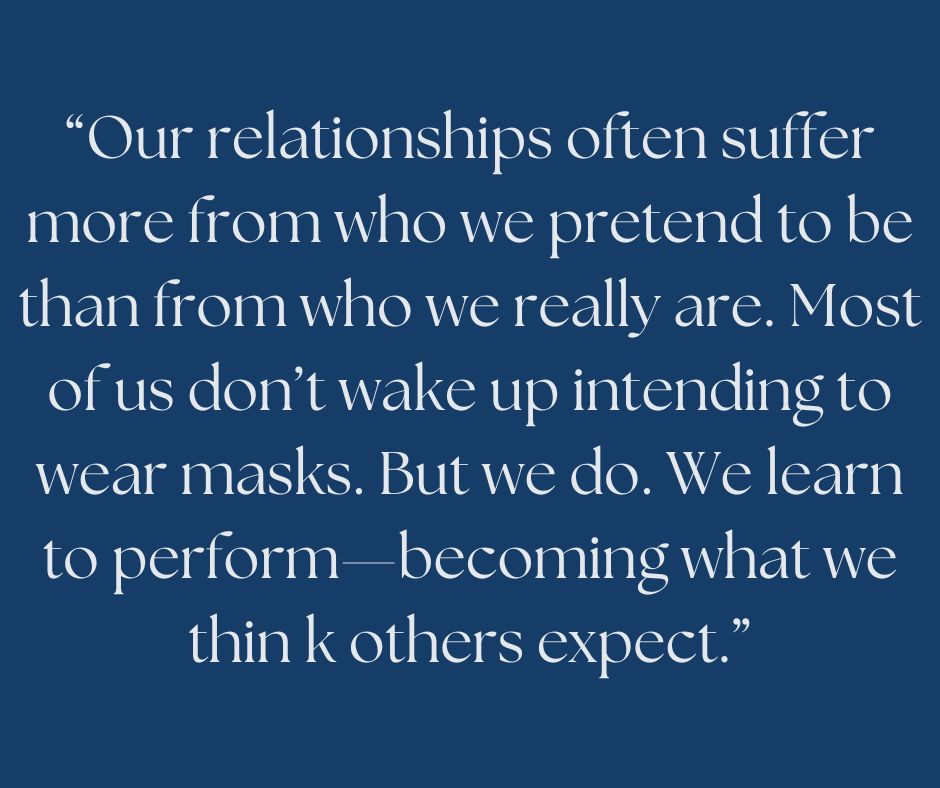
Our relationships often suffer more from who we pretend to be than from who we really are. Most of us don’t wake up intending to wear masks. But we do. We learn to perform—becoming what we think others expect: the competent leader, the smart thinker, the wise counselor, the fun friend, the kind person. These personas aren’t always false—but they’re rarely our whole selves. They insulate us. They make us look connected without letting us be connected. And the longer we lead with them, the harder it becomes to tell the difference between performance and real presence.
It seems that the older I get, the more I too ache for depth—for the kind of relational connection that isn’t managed or performative, but real. I find myself drawn to the intimacy of Love. But I’ve also learned that realness can feel risky. It doesn’t always fit the scripts we’ve inherited or the roles we’re expected to play.
I’ve noticed, in myself and others, how easily we drift into relational performance—how tempting it is to show up as the version we think others want. And occasionally, when I’ve tried to step out of that—when I’ve shown up more whole, more honest, less managed—it hasn’t always gone well. Sometimes, it’s actually strained relationships. Not because I intended harm, but because realness, even when spoken gently, can feel disruptive when it breaks the unspoken rules of performative relationships.
We often say we want authenticity, but it can be hard to hold. We promote vulnerability, but usually only the tidy kind. We confuse real presence with politeness, and treat honesty as something unsettling. And so we learn to hide, to shrink, or to stay surface-level—until we’re no longer known. Or worse, we start believing that showing up as our true selves isn’t welcome—or even safe.
Now, let me be clear… healthy relational boundaries are good. Necessary. But sometimes what we call boundaries are actually refusals and resistances. Refusals to tell the truth. Resistance to discomfort. Refusal and resistance to Love. And when that’s the case, they’re no longer about our health or wholeness…they’re about protecting our fears. Relational walls built from fear often masquerade as “boundaries”—but instead of protecting connection, they block it. What could have been thin place becomes a place of confusion and disconnection.
So what does it mean to risk realness—to show up heart-open, unmasked, and truth-told?
It means choosing to explore your actual being over managing your image.
Embracing silence long enough for truth to speak.
Not offering a right answer, but an honest response.
Receiving someone’s reality without rushing to fix or frame it.
Risking realness—not for shock value, but for the sake of showing up.
And trusting that thin places are holy spaces.Thin spaces aren’t always comfortable, but they are always sacred. And they open when we forget about ourselves and stop trying to be impressive, good, or right—and instead dare to be real. They form when we refuse to posture and choose to be present.
So today, may you risk realness.
May you help create thin space—holy space—for others to do the same. -
It’s almost gardening season here in the Adirondacks. Almost, but not yet. Although the sun is shining on most days, those pesky May frosts will teach patience to any overly eager gardener. And as we practice waiting—while preparing both ourselves and the soil along the way—I am reminded of this:
You can’t force a plant to bear fruit on command. Not by yelling at it. Not by pruning it into submission. Not by standing over it with a spreadsheet and a deadline. Not with executive orders, memos, or discipline committees. Yet, still, we try—and I’m not talking about plants.
We try in relationships, in institutions, in churches. We build systems—both external and internal—with rules and data, metrics and punishments. We tell ourselves that if the authoritative pressure is heavy enough, the outcome will be good. Once we get control of the soil, the conditions, the plant… maybe then we can manufacture something of value. But fruit doesn’t grow like that. Not real fruit. Not the kind Paul spoke of:
“The fruit of the Spirit is love, joy, peace, patience, kindness, goodness, faithfulness, gentleness, and self-control…” —Galatians 5:22–23
Paul didn’t write those words as a motivational list. He wasn’t coaching behavior. He was naming the visible evidence of a life well-grounded and faithfully lived. The signs of an invisible rootedness. The abundance of a life not bound by the way of law—whether religious, cultural, or political.
Paul knew something we tend to forget: you can’t cultivate Spirit-fruit in empire-type soil. Not then. Not now. It just won’t work. And when we try…we end up with something more bitter than Spirit-fruit.
Empires—whether Babylon or America—run on a different kind of law than the one Paul was talking about. They run on law rooted in fear, competition, and control. It doesn’t matter if that empire is Rome, the American consumer rat race, an oppressive religious or militant regime, or the co-opted-faith-based-entertainment-machine we often call church.
And empire isn’t just “out there.” It gets inside us. It is both the soil we operate in—and the nutrients of our life…and it is the antithesis of the Spirit. The way of empire always demands and requires. Empire produces pressure, not patience. Focuses on appearance, not gentleness. Judgment, not hospitality. Disgust, not regard. Compliance, not joy. Control, not freedom.
So when we don’t see the fruit of the Spirit in our lives, we might be asking the wrong questions. We often ask: How can I do more? Be better? Try harder?
But Paul might ask something simpler: What power are you presently living under and practicing? Because the Fruit is not the problem. It’s usually the impatient gardener.
Today, I invite you to notice the condition of your spirit. What power is working in you… and through you? Are you fluent in shame? Do you easily see the wrongs of others, but rarely your own? Are you driven by judgment? Do you see yourself as good and right—and others as broken, misguided, even disgusting? Are you tuned to fear? Do you worry about losing some previous “way of life” or “sense of order,” and feel a need to control things to keep it all from slipping away?
Then maybe the absence of Fruit in your life isn’t failure. Maybe it’s wisdom of the Plant…a Spirit-refusal to bloom under the wrong sun or out of season. Because the fruit of the Spirit doesn’t grow until it’s ready. It will not respond to coercion. It cannot grow in the season of fear. It does not serve empire—or answer to its ways.
The Spirit grows where great patience reigns. Where Love is the soil, not the reward. Where joy is unscripted, not scheduled. There’s a wildness to this fruit that no system can replicate. No program can manufacture it. No policy can contain it. And no act of judgment or condemnation can produce it.
It’s the fruit of another kingdom. A truer law and way. One that doesn’t require you to first behave—but invites you to first belong. To root yourself in the soil where Love really lives.
So if you’re tired of trying to force the fruit—maybe it’s time to stop. Maybe it’s time to ask: Am I willing to leave the empire ways behind… for something more holy and free?
Because the frost will soon pass. The ground will soften. The soil will wake up. Right where you are. Where I am. Right here. Even in Adirondack dirt.
-
Holy Saturday is about holy silence.
In such silence, we do not move quickly or seek to assign clarity.
We do not rush toward the next day or pretend disappointment has not occurred. Holy silence is the long exhale between “It is finished” and “He is risen.“The land of silence.
In Into the Silent Land, Martin Laird speaks of silence not as emptiness, but as a particular kind of presence—a presence that dwells beneath the noise of our thoughts, our griefs, our compulsions. Silence, for Laird, is not something we create—it is the very ground of our being, always there, waiting. It is Presence.
(Note: Laird’s book is the best I have ever read on the topic of Christian contemplative prayer.)Holy Saturday invites us into that Land of Silence.
It calls us to release our grip on controlling outcomes, to cease our striving to fix or explain, and to simply be. Not as resignation, but as radical trust.
It is the spiritual posture of rest without certainty.There is no spectacle on Holy Saturday.
No miracles.
No immediate answers.
No desperate prayers to change the reality of things.
Only grief.
Sadness.
Silence.And this way provides us with a practice of prayer—
a kind of prayer that changes the pray-er.With practice, as Laird writes, “The mind gradually becomes a more faithful servant of silence, rather than its saboteur.” This is an invitation to let silence become our teacher—not to conquer it or interpret it, but to consent to it. To wait with it. To dwell in it.
Silence as prayer—the way of Holy Saturday—is a practice we must learn,
for most of us are not naturally prone to such a way. And it is a practice that, I suspect, is particularly important in our current day.Silence is not absence.
It is presence beyond words.
It is trust in its most radical form.Silence reminds us:
Something is happening, even when we cannot see.
A greater Reality is unfolding beneath us, always.So we wait.
Not passively, but attentively.
Not despairing, but fully feeling.
Not alone, but with Presence. -
Today is Spy Wednesday, the quiet, often ignored, shadowed middle of Holy Week. It’s a day to reflect on betrayal.
The Gospel writers tell us that Judas Iscariot—one of the chosen twelve, a man who ate with Jesus, traveled with Jesus, laughed with Jesus—went to the chief priests and sold him out. Thirty silver coins.
Apparently, that’s what it took.
That’s all it takes.
Follow the money.Let’s not forget: the first act that set the crucifixion in motion didn’t come from Roman soldiers or an angry mob. It came from someone in his inner circle. Someone who knew him. Someone close enough to kiss him.
Betrayal always comes with intimacy. It requires nearness. And this is where it hits home.
It seems to me that the American church—especially those who wave the flag in one hand and grab for power with the other, sanctifying violence and calling it “just,” merging nationalism with theology and equating political access with faithfulness—has become Judas. And I wonder if those of us who stand by, wringing our hands and wishing it weren’t happening, are just as complicit.
Not because we delivered the kiss of death, but because of our deafening silence in the face of suffering.
We are betraying Jesus in the poor.
We are betraying Jesus in the immigrant child.
We are betraying Jesus in the unhoused, the hungry, the addicted, the uninsured.And still, we amen sermons and sing songs as if we are the faithful ones.
Surely we remember what Jesus said:
“Whatever you did for one of the least of these brothers and sisters of mine, you did it to me.”
To me.
Jesus. What have we done?
What does it mean that we’ve built systems that punish the poor for being poor? That we preach “family values” while mothers are caged and children cry behind barbed wire? That we claim to love justice and yet deny due process, ignore human dignity, and refuse hospitality?
We have pledged allegiance to empire while claiming false loyalty to love. Betrayal. We’ve become fluent in the words of worship—but illiterate in practice. Betrayal.
Spy Wednesday is not about remembering a single historical traitor.
It’s about recognizing the Judas in ourselves. It’s about confessing and confronting the ways we bend toward self-preservation rather than sacrificial love. The ways we pray in Jesus’ name but refuse to practice His way.This holy day in Holy Week invites a holy confrontation:
What have I sold out for a few coins?
What comforts have I chosen over compassion?
What version of Jesus have I created to avoid following the real one?Holy Week is not a sentimental reenactment of seder meals, seven last words, and a basket of Easter flowers. It is a mirror. And this time, Judas is standing before us, holding it up.
May we have the courage to examine ourselves.
-
Growing older is giving me strange and unexpected gifts—clarity, simplicity, and a deeper knowing of the kind of life I want to live. But these gifts do not arrive all at once, nor do they come through striving. They seem to reveal themselves slowly, often hidden behind the foolishness, complexity, or certainties I once held dear.
There is a particular exhaustion that comes from always striving but never arriving. It feels like treading water—working harder and faster yet staying in the same place. I see it in my own life and in the lives of so many around me: a restless anxiety that tells us we must always be productive, always improving, always securing our own future. The pressure is relentless. And the moment we pause, doubt creeps in: Have I done enough? Am I enough? If I rest, will everything fall apart?
Walter Brueggemann (Sabbath as Resistance) names this restlessness as more than a modern affliction—it has deep theological and cultural roots. The Protestant work ethic once tied faith to proving one’s worth through service, but over time, this emphasis on work became a broader cultural expectation: our worth is measured by what we produce.
Neuroscience helps explain why this belief is so deeply ingrained. Our brains are wired for reward-seeking behavior, and in a culture that equates worth with productivity, we become addicted to the dopamine hits of achievement. Psychologists call this the hedonic treadmill—the cycle of chasing the next goal, believing it will bring fulfillment, only to find the feeling fleeting. Meanwhile, our nervous system remains in chronic stress, conditioned to stay in a constant state of striving.
We see this everywhere: the pressure to sink or swim by our own effort, the belief that treading water is never enough—we must always be moving toward the next goal, the next success, the next win.
But at what cost? This cultural script is exhausting and dehumanizing. It leads to burnout, stress, loneliness, anxiety, and a gnawing sense of inadequacy. It cannot produce healthy, whole people.
We struggle to rest because we’ve internalized the lie that to stop striving means failing. That rest equals weakness.
Yet, the wisdom of spiritual traditions—and the rhythms of nature and our own bodies—tell a different story. The good life is not about endless striving but about learning to trust, to let go, to surrender. To develop a rhythm of rest.
If treading water is the metaphor for anxious striving, then floating may be the image for rest. Floating requires trust—it means being held up by the water’s buoyancy rather than fighting against it. Science confirms that when we allow our nervous system to shift into rest (what some researchers call the relaxation response), our bodies heal, our minds clear, and our sense of connection to others deepens.
The reality of being held means recognizing that we are sustained by something greater than ourselves. It means allowing grace, community, and Presence to uphold us instead of exhausting ourselves trying to stay afloat. It means believing we are loved and worthy—not because of what we produce, but simply because we are.
So how do we move from treading water to being held? It begins with small, embodied practices:
- Pausing before reacting – Creating moments of stillness, even mid-conversation, to remember we do not have to prove our worth.
- Practicing sabbath – Intentionally stepping away from productivity to embrace rest as a sacred act.
- Breath prayer or silent sitting – Letting go of the need to fill every moment with thought or action.
- Leaning into relationships – Allowing others to help carry what we were never meant to bear alone.
The great gift of being held is this: We were never meant to hold ourselves up alone. We do not have to prove our worth through ceaseless effort. We are already being held. The only question is whether we will trust the water of reality enough to stop flailing and let ourselves float.
You are.
I am.
Here. -
Today I am sitting in my usual Wednesday place…an intentional midweek practice of reading and reflecting. A few minutes ago I found myself reading through journal notes that I wrote nine years ago today—reflections, fears, and wonderings that were at work in me as our family was preparing to relocate from the Kansas City area to the Adirondack Mountains of New York State.
In my notes, I referenced two quotes—words that, in hindsight, both served as inspiration then and have guided so much of the past nine years in my life.
“I will purge my mind of the airy claims of church and state, and observe the ancient wisdom of tribesman and peasant, who understood they labored on the earth only to lie down in it in peace, and were content. I will serve the earth and not pretend my life could be better served.” —Wendell Berry in Art of the Commonplace
“Now as always, prophetic imagination depends on great intentionality, and it requires a host of reliable companions on the way from a failed world under judgment to a new world of good-news possibility. The ‘way’ is one of relinquishing what has failed (which we are likely to treasure) and receiving what God will give. It is a move from scarcity to abundance that is likely routed through lament to doxology.” —Walter Brueggemann in Prophetic Imagination (40th Anniversary version)
It struck me today that the link between the two quotes is grounded in the work Brueggemann called “great intentionality.” Berry’s wisdom invites us to be intentionally grounded—to stay close to what is real and generative…aware of the many airy claims bombarding our imaginations and keeping us from experiencing the reality of our world and life. In similar ways, Walter Brueggemann speaks of the great intention that is required for forward movement…out of the wontedness of our day and into a good-news kind of world where neighborliness, hospitality, and abundance have a say.
Current neuroscience and research in contemplative science reveal how powerful intentionality can be. Studies on mindfulness practices demonstrate that setting clear intentions shapes not only our mental focus but also our brain’s neural pathways. Psychologist Richard Davidson, a leading researcher on contemplative practices, highlights that intentional practices like meditation, gratitude reflection, or mindful walking can alter the brain’s default mode network—the system tied to rumination and anxiety. Intention itself, Davidson argues, is key to rewiring these mental patterns, helping us move from reactive states to responsive presence.
Similarly, social science research has found that intention is closely linked to resilience. Psychologist Angela Duckworth’s recent work on “grit” reveals that people who develop intentional habits in pursuit of meaningful goals experience greater perseverance and life satisfaction. The act of intention itself, in this sense, anchors us in purpose and meaning even when circumstances are uncertain.
Yes, living with “great intention” requires both Berry’s rootedness and Brueggemann’s readiness to relinquish. Berry reminds us that true contentment is always found in embracing the truth of the ground beneath our feet—the realities and limits of our earth, bodies, relationships, and daily tasks. And Brueggemann cautions us against clinging to what no longer serves us, urging us to move forward with courageous imagination and reliable companions (I need to explore more on the importance of reliable companions in a later post!).
It seems then, that great intention invites us to dwell fully in the present while remaining open to what is yet to come. It teaches us to ask: What am I actively holding on to that no longer serves life? What am I actively resisting that might bring newness and hope?
Perhaps this is the paradox of intention—it both roots us while calling us to relinquish. It steadies us in what is real while preparing us for what is possible. Like planting a garden, great intention requires us to experience depth and grittiness of the soil of our lives while trusting that something new will emerge in good time.
And as Brueggemann reminds us, the way forward is often “routed through lament to doxology.” We let go, we grieve what is gone, and in doing so we make space to sing a new song for new life about to unfold.
So today, perhaps the most intentional act you can take is to pause. Plant your hands in the soil of your own life. Ask what is good for you to invest in and what is inviting you to move on. In that space—between grounding and growth—may you discover the gifts of living with great intention.
-
Subscribe
Subscribed
Already have a WordPress.com account? Log in now.
 Shane Ash