-
This third week of Advent invites us to the practice and experience of joy. As we examine joy, we can draw insights from both the spiritual wisdom traditions and the advancing field of gratitude science.
Joy is often mistaken for a feeling of happiness, but as Dr. Pamela Ebstyne King, a professor at Fuller Theological Seminary, explains, joy is best understood as a virtue—a habit that can be cultivated. Unlike emotions that are summarized stories within our body, virtues are cultivated qualities of one’s being that shape how we live and relate to others.
Research supports this deeper understanding of joy. Dr. Barbara Fredrickson’s broaden-and-build theory reveals how joy can enhance our creativity, resilience, and social bonds. Joy isn’t merely a personal experience; it equips us to engage with the world purposefully, even in times of struggle. And, as theologian Willie James Jennings suggests, joy can be an act of resistance against despair, empowering us to contribute to a greater good.
Gratitude is the on-ramp to joy. When defined as the conscious appreciation of life’s gifts, gratitude shifts our focus from scarcity to abundance, helping us taste and see life’s goodness. Neuroscience shows that gratitude rewires our brains, counteracting the negativity bias that keeps us fixated on predicted problems. By consciously focusing on moments of thankfulness, we amplify positive memories, reduce stress, and increase overall well-being. Simply put, the science shows that people who practice gratitude feel more grateful. Imagine that!
But gratitude is just the beginning of things. Today, we are claiming a life of joy. And joy is a life of sustained gratitude—a life that is trained to see beauty, goodness, love, and the sacredness of all things. Joy is the energy of Great Connection.
I have developed a practice that I use daily and often share with those whom I provide spiritual direction. I call it the “FOR ME?!” practice. Pick anything—the chair you are sitting in, the sunrise, the snow-covered landscape, the clothes you are wearing, anything—and recognize it as a gift. Look deeply into its reality—the many hands that designed and built the chair, the wonder of another sunrise, the numerous people (and their stories) whose work brought your clothes to your closet. Look attentively and deeply; you might uncover stories beyond your imagination that are directly connected to your everyday life. And then, humbly and baffled (there’s both a question and an exclamation mark), exclaim aloud, FOR ME?! You will sense something happening within you as you begin to recognize the gift hidden in everything and everyone.
There is no shortage of gifts being given to you in this moment—your breath, your heartbeat, and, well…everything and everyone. What is missing is your conscious attention to the radical goodness and beauty of life. The socially promoted mode of scarcity has blinded us to our abundance. Yet, an intentional practice of sustained gratitude can transform us.
Try it…and you will see.
-
Peace, in the Advent way, is not a magical moment we happen upon; Advent peace is cultivated through intentional action. This kind of peace does not avoid the suffering or messiness of life but includes it, transforming it into seeds of learning or something greater. Just as God’s action in the Advent story reveals peace through the incarnation, our own actions—when rooted in love and intentionality—can shape both an inner and surrounding world where peace thrives. Image reflects Image!
But what does intentional action look like in our daily lives? It likely begins with small, personal commitments: carving out moments for sacred silence, setting aside distractions to truly listen and be present with others, or extending kindness where grouchiness might otherwise reign. These are acts of personal agency (last week’s theme) that ripple outward, touching lives in ways we will never fully see.
The Advent invitation to intentional action also calls us to examine the world of systems and relationships we inhabit. Are there ways we can contribute to greater harmony in our families, workplaces, or communities? The path to peace often requires great courage—naming injustices, forgiving past ignorances, or working for justice where inequities persist.
This is where peace deepens into Shalom—a wholeness that encompasses mind, body, and spirit…and all surrounding things. It is not utopian perfection but a journey toward attunement: with Reality, ourselves, and others. Such alignment requires great intentionality (and others also exercising agency and action) to step into the uncomfortable but necessary work of deep reconciliation and restoration.
As we light the second candle of Advent, let us reflect on this: peace is not a fleeting emotion or a distant imagined ideal. It is the evidence of a present life lived with intentional action—a life that mirrors the active love of God.
Today, may you dare to take the next action, however small, toward the wholeness you are invited to embody and share.
-
Advent is a season for dreamers and truth-tellers, for poets and prophets. It’s often described as a time of waiting, but Advent is not about passive waiting. Instead, it’s a call to agency and action in the waiting—a naming of the tension between our deepest longings and the reality of what is and a movement from despair to active hope.
In this first week of Advent, hope emerges as the essential action for living well within this tension. Hope is a combination of possibility and pathway. It acknowledges that the present reality doesn’t yet reflect the life we long for or the future we desire, but it also sees that, with intentional action, change is possible. Hope invites us to name our longings, confront our reality, and take action in new ways. Despair is the opposite of hope…a loss of agency and action.
It seems to me that naming our longings requires the daring work of contemplation – a thorough examining of our inner expectations and discerning how much of our felt experience is shaped by our own imagination, fears, and projections. Naming reality also demands courage—the bravery to face the inner pain, fear, and resistances that obscures the possibilities of goodness, beauty, and joy of the present moment.
Last week, I witnessed this tension in a powerful moment of raw vulnerability. Someone shared their longing for freedom from the weight of fears and past wounds. As tears flowed, I saw them experience both the ache of what was missing and the quiet healing spark of what could be. That spark—hope—didn’t deny the pain but dared to proclaim the possibility of newness. And in that moment hope, of engaged agency and action, they shifted from despair to an active participation in the reality of their life.
This is the hope of Advent: the invitation and boldness to say, “This is not how it has to be,” followed by the courage to declare, “Therefore, I can and will…”.
-

For those who have fully experienced the mirror of Love, there comes a moment in time when they know that everything has changed. What is the mirror of Love? It is a glimpse and awareness of our truest and most loved Self. It is an inner awareness and resting in our inherent goodness and belovedness.
When this reflection happens and we see the image of our true self, something occurs within oneself that seems indescribable with words, yet is fully knowable, attainable, and real. This knowing differs from the frail certainties, rational thinking, and survival instincts we typically rely on in life. It is a knowing not based on the logical sorting of the mind, but one that resonates in the soul—that collective space within us where all our parts gather to perform the dance of our experience.
The mirror of Love can appear in our lives in countless ways: through nature, relationships, moments of awe and wonder, or conversations where we feel deeply seen and heard. There seem to be very few limits, if any, to how the mirror of Love can be experienced. For it is not some magical formula that conjures up the experience of Love; rather, it is the slow and trusting work of opening our protected soul—our innermost and truest self—and becoming a hospitable home for Love.
Love itself is always present in life: inviting and wooing, always offering and extending. It is our protective boundaries, doubts, projections, and fears that lock out the indwelling reality of Love.
Yet, as we learn to identify our resistances and let go of our fears, we—within our very bodies—become a dwelling place for the abundance of Love itself. Our bodies begin to rest, our minds stop scrambling to understand, and we simply know Love is at home, and we are the home.
As we become more and more aware of the nearness and reality of Love, the distinction between Love and our own self becomes increasingly blurred. Perhaps even, the boundary of “self” isn’t as distinct as we once thought—only another illusion and projection of the fearful self.
How do we begin? How do we position our lives to receive and reflect Love? Well, any effort to provide a 1-2-3 step plan won’t work, because every life and every story is unique. Yet, there is always an initial action… a beginning moment. Love always begins with “Yes.”
-
While continuing to reflect on my past year of spiritual practices, I want to spotlight an often overlooked practice: self-befriending.
If I had to choose one defining word for my inner reality over the past few years, loneliness would be the word. It has required significant spiritual practice to recognize and name that gnawing reality within me…for the loneliness went beyond a mere emotion; it became a constructed state of existence shaping my daily thoughts, feelings, and actions. I was loneliness. It was my identity, albeit a false one.
In such a state, one can be surrounded by many others, yet never fully able to rest or trust within those relationships. And this sense of loneliness often creates an intense craving for connection, even while the I-am-loneliness identity makes it almost impossible to form mutual connection with others.
Reviewing the forty-six years of life-happenings that formed my reality into such a state requires more narrative landscape than this brief blog post can contain. Suffice to say, life happens and subsequent patterns form. Yet, with great intention, awareness, and practice…just as the patterns formed, such patterns can be transformed.
Ironically, one of my transformative moments was the recognition that I was not alone in my state of loneliness. I have discovered in my journey that many people endure such self-judgements of being an “outsider.” Many of us are walking through our lives with the ache of not being good enough for relationship with life, others, and ultimately, our own self. If there is good news in this misery, it is this – you, and I, are not alone in our loneliness!
Matter of fact, there is an abundance of active research exploring the concerns and the increasing experiences of loneliness within our society. I am particularly influenced by Dr. Vivek Murthy’s (the current U.S. Surgeon General) work on the issue. In his recent advisory, he identifies many of the causes and negative effects of loneliness on both personal and societal wellbeing as well as the importance of friendship and social connection. Of important note, broadly within the research it is acknowledged that the quality of connection is what matters most. Having just a few meaningful friendships can be transformative. Yet, for many of us, before we can authentically experience such meaningful connections we must engage a healing practice…the practice of self-befriending.
Befriending one’s self. For some, certainly it was for me initially, that sounds like an odd task. I grew up thinking that my self was something I was supposed to reject. That I, at the level of my core essence and being, was inherently wrong, broken, bad, sinful, and that I should want to be rescued from myself. I have discovered this to be rooted in a mis-constructed idea of poorly designed religion. And for many, as it was for me, their deep loneliness remains tethered to this narrative.
The awareness of loving oneself or befriending oneself has been around a long time. Almost every healthy religion summarizes itself with a “Golden Rule” = to love the neighbor as yourself. Loving one’s self is a prerequisite to genuine love of others. Self-befriending precedes any and all healthy friendships.
So, how do we practice self-befriending? For me the practice took a long route. In my years of loneliness I have attempted a few remedies along the way in an attempt to calm the ache; some more healthy than others. However, nothing soothed the core wound. Those efforts include trying to manufacture close friendships; but come to find out, deep friendships require a mutuality of commitment and interest. And so the ache remained even while I found myself often surrounded by people. I was stuck in a longing for connection and hoping for meaningful conversations. And as long as I believed that others were the answer to my ache, I remained stuck.
While the idea of a meaningful connection being the cure for my state of loneliness was not misguided in its purest form, my attempts to manufacture friendship or await chosen-ness was shortsighted. For the answer to the ache of loneliness so many of us sense is not something, or someone, outside of our own self. The answer to meaningful connection with others begins with… befriending oneself. Out of that practice will begin to flow meaningful connections with others.
There is not a 1-2-3 plan for the practice of self-befriending. Every person will have to bushwhack a pathway of their own. But I can share with you some of the elements and signposts that will guide you along the way.
First, self-befriending begins with an everyday practice of stillness and silence in order to listen to one’s own thoughts. Set aside 15-30 minutes a day to just sit and listen. Give close attention to any tensions in your body and any repeating thoughts. Acknowledge them with a simple, “I see you, and you are loved.” Befriending means…be your own friend! In these moments of restful listening and loving-kindness, it will begin to feel like an intimate dance with your own soul, a conscious interaction with your own consciousness.
Second, imagine forming a connection so deep within your own self that you become your own steadfast ally, a confidant of support, a cheerleader for your own life. Speak kind encouragement to yourself. Be overly gracious. For the measure of grace you give will be the measure of grace you experience! (Luke 6:38) The more loving you become, the more Love you experience. (1 JN 4:8).
In this time of sacred alliance, you will learn to recognize and celebrate the quirks and uniquenesses that make you truly human. Your failures will become wisdom-forming experiences rather than paralyzing shame stories. You will begin to embrace life exactly as it is…while simultaneously engaging the necessary work of healing, restoration, and re-formation. With consistent and conscious practice, you will cultivate a gracious inner conversation, and in response, you will find yourself acting in life with more courage and compassion.
Ultimately, self-befriending is the spiritual practice of compassion. And as we learn to engage compassion within, it shows up and strengthens our friendships and social connections. The rest and transformation we experience in the process is a sign that we are no longer stuck in shame, judgment, comparison, and the constant pursuit of external validation.
Don’t knock it until you try it…and I am sure every one of us can benefit from more loving-kindness. Practice makes perfect they say…so practice friendship.
-
Last January, I wrote these words in my journal: “This year I must change. Where will I begin? How will the change happen? I reckon it will require intentionality, self-awareness, determination, and a group of faithful companions along the way.”
The recognition and commitment was a good beginning, but the real work of change came after. The past year has demanded many moments of remembering the goal and stop-and-starts to stay focused on the moment. Thankfully, I was aware enough to admit that while I was fully responsible for self-change, I would also need others to help mirror life back to me in ways I was unable to see.
Like any life, there were a complexity of reasons that led to the moment: the environments I found myself in, the relational patterns I was forming, and the personal practices (or lack thereof) that I was engaging. Or as they say…people, places, things…and doings. However one wants to calculate it, the bottom line was obvious—I was not fully living, not fully present in the here and now, and not fully engaging my own sense of agency. Instead, I mostly floated disassociated through days at a time, living within a barrage of negative thoughts and imagined stories. And my body was mirroring the chaos of my mind—anxious, pained, and increasingly weak. Meaningful conversations were scarce, and deep connections nonexistent. It was not that other people didn’t exist in my life, but as I can now see, it is impossible to truly experience meaningful connection or love when one is not present to themselves. And as long as I remained absent to myself, I was unable to be present with others.
Thankfully, I could see what was happening, I wanted to change, and I knew change would require a new set of practices. I would have to train myself differently if I wanted to experience a different kind of life.
And so it began. I wrote down four words that represented my commitments for the year:
- Intentional: I am responsible for my daily actions, developing routines, and my own contentment.
- Connection: I will connect with at least 3 people per week who energize me and foster conversations that deepen me.
- Awareness: I will pay attention, without judgment, to the here and now. I will pay attention to what is happening within myself.
- Relinquishment: I will let go of practices, patterns, and plans that are not working.
Today, I am pleased to look back and see the progress of the past year. I have honored each commitment in various ways and experienced significant transformation. The baseline of my inner awareness is one of joy, contentment, and rest. The daily routines in my life are dramatically different.
There are many insights from the past year that I will write about in the months to come, but the single most impactful practice is undebatable. The commitment to weekly connection and conversation has been the core inertia for change.
Throughout the next month, I will share more about what I have learned about how friendship is a transformational practice. But for today, I want to acknowledge a handful of friends (Paul, Letiah, Jamie, Casey, Danielle, Matthew) who have each spent hours of time in conversation with me over the past year. Each one of them represents a different part of me that has been seen, heard, recognized, held, and ultimately loved in our time together. I believe the experience was mutual.
Our conversations were fairly simple in structure—checking in with one another, discerning decisions together, telling stories, dreaming about projects or possibilities, allowing our lives to be seen through a different lens, and mirroring back to one another the other’s inherent worthiness. Each of them knows the intentionality of our time together…and for each of you, I am grateful.
As I begin to unpack the experience of the year, I am foremost aware of the transformative kind of love I have experienced in these friendships. A kind of love that empowers and strengthens one another. An unwavering belief in the goodness of the other, and a recognition and celebration of the capability of the other.
What I have experienced in these friendships reminds me of the O’Donahue insight about the nature of a true friend: “A friend is a loved one who awakens your life in order to free the wild possibilities within you.” (John O’Donohue, Anam Cara: A Book of Celtic Wisdom, 19)
So, as this calendar year winds down, I write this reflection as a practice of gratitude. Thank you.
And to each of you I offer you back this blessing, “May you recognize in your life the presence, power, and light of your soul. May you realize that you are never alone, that your soul in its brightness and belonging connects you intimately with the rhythm of the universe. May you have respect for your own individuality and difference.” (O’Donohue)
Let’s run it back!
-
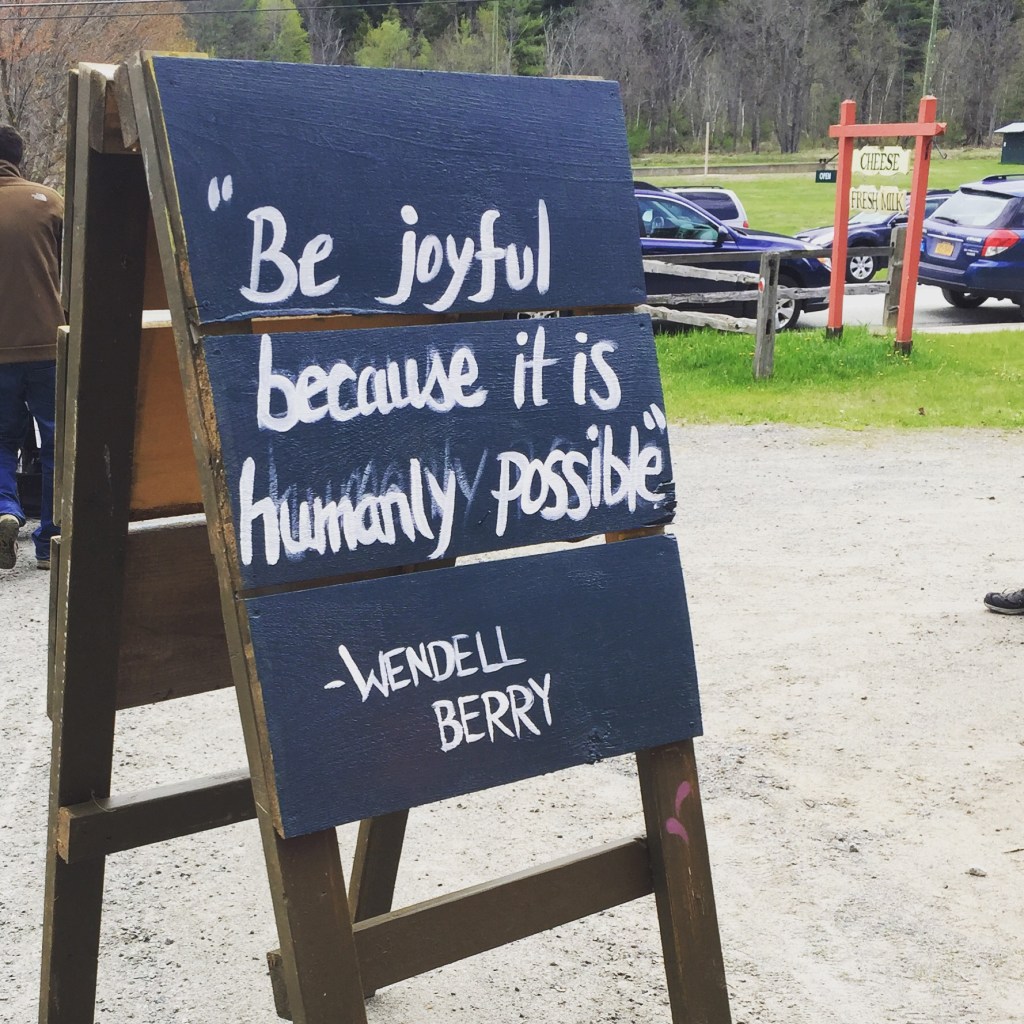
I am still learning the virtue of joy. And I confess, it is not a virtue that forms easily in me.
In the virtue science research world, Pamela King and Fredric Defoy have studied joy and concluded that joy is “a virtue, a psychological habit, comprised of characteristic adaptations and given meaning by transcendent narrative identity. Thus joy involves knowing, feeling, and enacting what matters most.”(1)
I used to think joy was something that would happen to me. That I would finally be joyful when the perfect and right circumstance happened, the right relationships showed up in life, or when I was finally able to get that perfect new shiny thing. Today I understand that the formation of joy requires intentional practice…it is a developable habit and formable human characteristic.
How do I practice joy? For me, the practice of joy requires that I awake each day and choose gratitude over anxiousness. And perhaps the mere recognition of my agency and ability to choose is the first evidence that I am practicing joy. For, not all that long ago, it was a surprise to me to learn that anxiousness is an internal reaction rather than an imposed reality. Yes, the inner suffering of anxiousness can be resisted, and the first step is granting yourself the freedom to choose gratitude over anxiousness.
I remember when I was too distracted to recognize there was a choice. I assumed “busy” and “important” and “productive” were the normative and required ways of life. The anxiousness of needing to be busy consumed me. “I was busy to feel important and since I was important, I must be busy” was the unspoken script. This kind of busyness demands an allegiance to anxiousness. And anxiousness becomes the fuel that allows us to survive the busyness! What an exhausting race to death.
Joy begins with a choice: a determination about what matters most. And a pattern of knowing what matters most and acting upon it…that is what develops into a virtue of joy.
So, today…let’s be joyful. Because we can.
-

“We live in a time when being hopeful is a political statement. So strong is the tide of anxiety that rises around us that simply being unafraid seems radical and refusing to target others for blame seems somehow subversive.” – Steven Charleston
Hope is an act of resistance. And a life lived with hope is a life confusing to the fear-mongering media heads and the blame-dealing politicos who want only to profit from our anxious attention. A life lived with hope resists the religion of data that desires to reduce the meaning of life to what can be sold, stored, and sorted. A life lived with hope insists that individual agency and the unique experiences of a particular life matter.
Yes, the resistance of hope is not a wishy-washy dismissal of reality…but a necessary and sustaining practice that insists your life, the life of others, and the world we all share is a good, very good, gift.
Psychologist C.R. Snyder once developed a theory of hope that defines hope as having three main components: (1) Goal – a desired result, (2) Pathway – a plausible route to achieve the goal, (3) Agency – a belief that it can be accomplished.
Today, I invite you to reflect upon your life and this day. Take a moment and describe your hope for the day using Snyder’s three components. What is your primary goal for today? How can it be accomplished? When will you do it?
-
Subscribe
Subscribed
Already have a WordPress.com account? Log in now.
 Shane Ash